
“AI proposal software” now covers three very different things: proposal platforms that added an AI writing assistant, AI presentation makers that can produce something proposal-shaped, and a newer category that generates the proposal from your actual deal data. Which one you want depends entirely on which part of proposal work hurts most. Here's the field as of October 2026. (If you're still working out what the AI should and shouldn't do in a proposal, start with our guide to AI sales proposals.)
Veew: deal-aware AI (that's us)
Veew is AI sales proposal software that starts from the deal instead of a prompt or a template. Connect your CRM (HubSpot, Salesforce, Pipedrive, or Attio) and your notetaker (Granola, Fathom, Fireflies, tl;dv, Avoma, or Read AI), pick the deal, and the AI writes the proposal for that prospect: summary from their goals, challenges from the call, pricing from your product catalog, case studies only from your approved library. It's designed by a brand-enforced layout system and delivered as a trackable link plus a matching PDF, with engagement written back to the CRM deal on paid plans. The same drafter writes sales decks and one-pagers. Every document you publish for a deal also lands in the deal space, one link for the whole deal that builds itself as you publish, so the buyer never hunts for the current version. On the Team plan, you can also ask for a draft from Claude or ChatGPT: Veew's MCP connector hands the conversation to the same drafter, and the result is a draft you review in Veew. Pricing is Free, Starter at $19 a month for one person, and Team at $39 per seat.
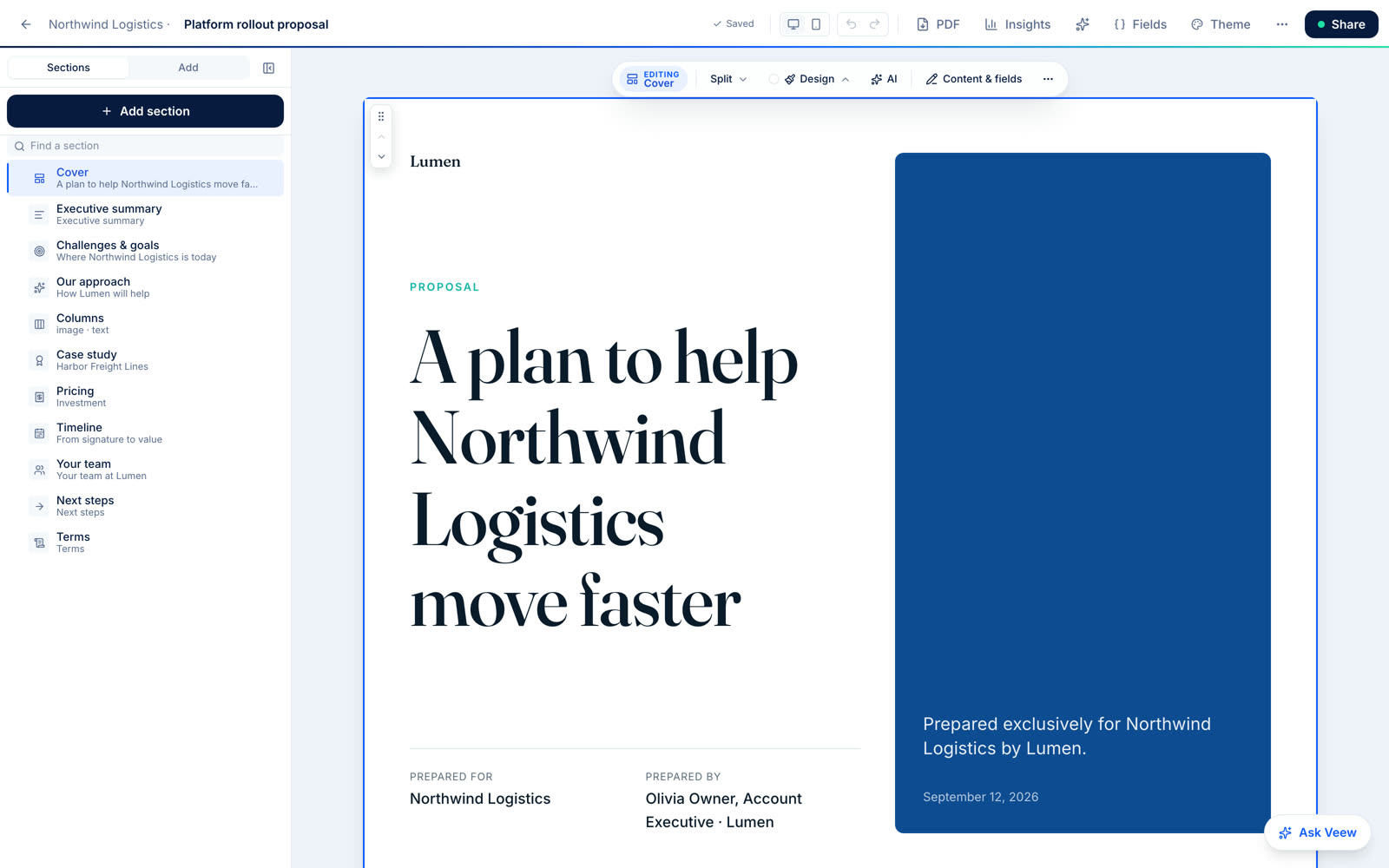
- Strongest at: prospect-specific narrative with zero re-typing; brand consistency without a designer; proof that's guaranteed real.
- Not the choice if: you need built-in e-signature, CPQ, or approval workflows today (there's a lightweight Accept step, then we hand off to your e-sign tool), or you want a platform with a decade of enterprise deployments behind it. We're a young product.
PandaDoc: the workflow platform with AI assist
The most complete document platform in the space: proposals, quotes, contracts, e-signature, payments, and deep CRM integrations, with an enormous template library, and now CPQ for HubSpot. Its in-editor AI is a writing assistant, helpful for rephrasing more than for drafting a deal-specific document from your CRM and call notes. It also has an official Claude connector and a ChatGPT app (both MCP) that let your assistant create, edit, and send PandaDoc documents for signature from the chat.
- Strongest at: the full close: e-sign, payments, approval chains, audit trails. If your bottleneck is executing documents, this is the safe pick.
- Not the choice if: your bottleneck is writing the proposal itself. The connector can carry text your assistant wrote into a document, but the facts are whatever the assistant was given. (Our detailed take: Veew vs PandaDoc.)
Proposify: proposal ops, with AI in the editor
A mature proposal platform with strong document analytics, now on a rebuilt version (Proposify 3). Its AI works inside the editor: highlight text, write a prompt, and it rewrites or tailors that passage. Its standalone AI proposal generator page says the tool is being reworked, with an early-access signup in the meantime. Either way, the AI assists with wording rather than composing the proposal from your deal.
- Strongest at: proposal process at scale: templates, approvals, metrics on what sections win.
- Not the choice if: you want the writing done for you per-deal. (Veew vs Proposify.)
Qwilr: the interactive web proposal pioneer
Qwilr made proposals into interactive web pages years before it was fashionable, and it's still the most polished at embedded video, interactive pricing, and accept-and-pay flows. Its Smart Proposal Engine is the closest thing here to deal-aware generation: CRM data comes in from Salesforce, HubSpot, Pipedrive, and others, AI extracts details from call transcripts and meeting notes, and admin-built rules and conditional content assemble the page. It's on the top Scale plan, and pages that use AI count toward credits.
- Strongest at: gorgeous interactive proposals with calculators and payment built in, and RevOps control over what adapts per deal.
- Not the choice if: you're a small team that wants AI drafting without buying the top tier, or you'd rather the AI write the narrative than fill a rules-based template. (Veew vs Qwilr.)
Storydoc: interactive decks at volume
Philosophically close to the web-proposal camp: interactive documents with per-slide analytics, plus a large library of vertical templates and “maker” tools. Its AI builds a document from a prompt, your website, or uploaded files, and CRM data from Salesforce or HubSpot pre-fills prospect details. Pricing calculators, e-signature, and payments are available, but personalization is prompt- and field-driven rather than written from the call.
- Strongest at: marketing-grade interactive collateral at volume: decks, one-pagers, reports.
- Not the choice if: you want the narrative written from your discovery notes, or quotes built from a product catalog. (Veew vs Storydoc.)
Gamma: the AI presentation maker
Not proposal software, but it ends up on every shortlist because the output is so fast and so pretty: prompt in, polished web-native deck out, and its agent can research the web, restyle a whole deck, and take edits in conversation. For a proposal-shaped document it can absolutely produce one. It just doesn't know your deal, your pricing, or your customers, so everything specific arrives by you typing or pasting it.
- Strongest at: general-purpose presentations, instantly, for everyone in the company.
- Not the choice if: the document needs deal data, real pricing tables, or proof you can stand behind. (Veew vs Gamma.)
ChatGPT: the DIY option
The cheapest path and sometimes the right one: with good prompting and your own context-pasting, ChatGPT drafts solid proposal copy. You supply the facts, police the hallucinations, and design the document elsewhere. We wrote a full guide, ChatGPT prompts for sales proposals, including where the approach stops scaling.
How to actually choose
- Bottleneck is signatures and process → PandaDoc (or Proposify).
- Bottleneck is interactivity and payment on the page → Qwilr.
- Bottleneck is volume of pretty collateral → Storydoc or Gamma.
- Bottleneck is the writing and tailoring itself (every proposal an afternoon, every output generic) → that's the problem deal-aware AI exists for, and the one we'd obviously point you to Veew for. See the full comparison hub and decide with your own eyes.
One suggestion whatever you pick: run the trial on a real deal you lost, not a demo scenario. The tool that would have made that proposal meaningfully better is the one worth paying for.