
Most writing about AI sales proposals comes from vendors and stops at “AI saves you time.” True, and not very helpful. The useful questions are narrower: where the AI gets its facts, which parts of a proposal it should write, which parts it should never touch, and how you catch its mistakes. A fluent paragraph with the wrong price in it is worse than no paragraph.
This guide covers how generation works, the division of labor we think is right between the model, your systems, and your reps, the failure modes to plan for, how to choose software, and what to measure after you send.
What an AI sales proposal actually is
Three quite different things get called an AI sales proposal, and most disappointment comes from buying one while expecting another.
- A template with merge fields. The company name, contact, and deal amount drop into a fixed document. Reliable and fast, but it's automation, not AI, and every proposal reads the same.
- A chatbot draft. You describe the deal to ChatGPT, Claude, or a vendor's form and get proposal-shaped text back. The writing can be good; the facts are whatever you typed plus whatever the model filled in, and the result still has to be designed, priced, and fact-checked elsewhere.
- A deal-grounded proposal. The AI writes from the records your business already keeps: the CRM deal, the notes from the calls, your product catalog, your approved case studies. It drafts the narrative for that buyer and assembles it into a designed document, with the numbers and proof coming from systems rather than from the model.
When we say “AI sales proposal” in this guide, we mean the third kind. It's also worth separating sales proposals from RFP responses: RFP tools answer hundreds of procurement questions from a knowledge base, while a sales proposal is the document a rep sends after discovery to make the case for one deal. Much of the advice ranking for this topic is really about RFPs.
Where the inputs come from
An AI proposal can only be as specific as its inputs. A good setup draws on five sources, each with a clear owner.
- The CRM deal. Company, contacts and their roles, deal stage, amount, products discussed, close date. If you work in HubSpot or Salesforce, this is already structured and shouldn't be retyped.
- Call notes and notetaker summaries. The buyer's priorities, pains, and objections in their own words: the input that makes a proposal sound like the conversation. See our guide on turning call notes into a proposal, including what to pull from a Fathom or Granola summary.
- Your pricing catalog or CPQ. Products, packages, list prices, discount rules. This is the source of truth for every number in the pricing section.
- An approved proof library. Case studies, testimonials, and metrics that marketing or legal has signed off on, tagged by industry and use case so the right one can be found.
- Brand and structure. Your brand kit, your section order, any locked legal or security language, and the voice you want reps to sound like.
One rule covers all five: when an input is missing, the right output is a visible gap, not a guess. A bracketed placeholder that says [customer result] is a prompt for the rep. An invented result is a liability.
How generation works, step by step
Most deal-grounded tools follow roughly the same sequence. Knowing it shows you where errors can enter.
1. Assemble the brief
The tool gathers the deal record, the relevant call notes, your voice settings, and the proof that matches this buyer's industry and use case. This brief is all the model sees.
2. Pick the structure
A template decides which sections exist and in what order. Good systems let a template author attach standing instructions to a section (“keep this under 120 words,” “always mention onboarding”) so the AI follows house rules without the rep repeating them.
3. Write the narrative sections
The model drafts the prose: a summary built on the buyer's stated priority, the challenges in their terms, your approach framed around their requirements, and the next step agreed on the call. This is what AI is genuinely good at.
4. Insert structured content from systems
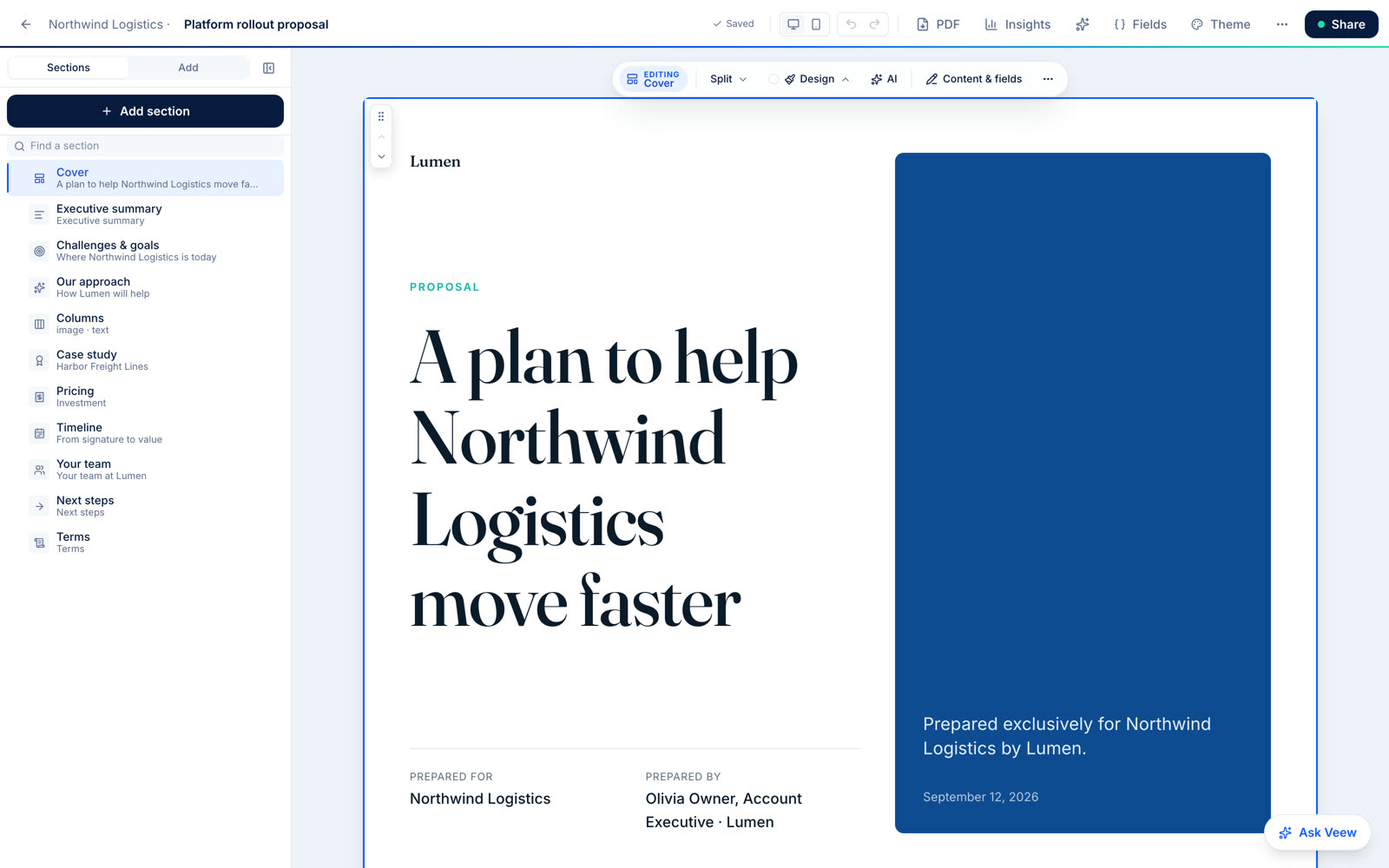
Pricing tables come from the catalog. Case studies and testimonials come from the library. The model may write a sentence introducing them, but it doesn't generate the numbers or the customer names. In Veew, for example, the pricing section is a structured block filled from your product catalog, and the AI is instructed to leave prices exactly as they are; if no approved case study fits, the case-study section is dropped from the draft rather than filled with something plausible.
5. Lay it out
The content goes into designed sections with your fonts, colors, and logo. Text in a chat window, by contrast, still needs an afternoon in a doc editor.
6. Hand it to a human
Every AI-written section should be marked as unreviewed until someone has read it. The rep edits, asks for rewrites in plain language (“shorter,” “more for a CFO”), fills any placeholders, and only then sends.
What AI should own, and what it shouldn't
This is the part most guides skip. Here is the division of labor we'd recommend, and the one we built around.
- The model owns the words. Summaries, restating the buyer's challenges, framing your approach for their situation, adjusting tone for the reader, first drafts of next steps, and rewrites on request.
- Your systems own the facts. Prices, discounts, terms, product capabilities, customer names, results, and any legal or security language. These come from the catalog, the proof library, and locked template sections.
- Your reps own the judgment. What to offer, what to promise, what to leave out, whether the tone fits this relationship, and the decision to send.
Prices come from your catalog or CPQ, never from the model
A language model predicts likely text, and a likely-looking price is not your price. Even with the right number in the prompt, a model rewriting a section can round it, move a discount to the wrong line, or restate a total that no longer adds up. The fix is architectural, not a better prompt: pricing lives in a structured table filled from the system that owns it, and the model can't edit it. If you run CPQ with approval rules, the proposal shows what CPQ approved.
Proof comes from an approved library, never from the model
Ask a model for a case study and it will write a convincing one, with a plausible company and a modest-sounding percentage. It's the most dangerous failure in proposal writing, because a buyer can check it. The rule should be absolute: the AI may only cite proof that exists in your library, and when there's no relevant proof, it says nothing rather than something.
A human reviews before anything is sent
Not as a formality. The reviewer checks what the model can't: that the call notes were read correctly, that the approach is something your team will deliver, and that nothing promises more than you can sign. Tools that send without a person in the loop are optimizing for the wrong thing.
Failure modes, and how to prevent each
Generic AI tone
“Unlock,” “seamless,” three-part benefit lists, no specifics. The cause is almost always a thin brief. Prevention: feed it the call notes, not just the CRM fields; set a voice with banned words and an example of your best proposal; keep sections short. If you're prompting a chatbot directly, our ChatGPT prompts for sales proposals cover the instructions that help most.
Hallucinated stats and customers
A “37% reduction in onboarding time” that nobody can source. Prevention: proof only from a library, placeholders when a number is missing, and a reviewer who checks every figure against its source before sending. If your tool can't show where a number came from, treat it as invented.
Wrong pricing
Prices drift when they live in prose. Prevention: a structured pricing table from the catalog, prices excluded from what the AI may rewrite, and a check that the total in the summary matches the table. Better still, don't restate the total in prose at all.
Stale case studies
The library says the customer is still a reference; the customer churned in the spring. AI surfaces old proof more efficiently, so prevention matters more: give every proof item an owner and a review date, retire anything past it, and tag items by industry and use case.
Misreading the buyer
The summary pins a concern on the wrong person, or a passing comment becomes a headline priority. Prevention: the rep who was on the call reads the summary and challenges first; only they can tell.
How to evaluate AI proposal software: a checklist
Whether you're looking at an AI proposal generator or a full proposal platform, run a trial on a real deal, ideally one you lost, and check:
- Inputs: Does it read your CRM deal and your call notes directly, or do you paste context in?
- Pricing: Do prices come from a catalog or CPQ into a structured table the AI can't edit?
- Proof: Can it only cite approved case studies? What happens when none fit?
- Review: Are AI-written sections clearly marked until a person has read them?
- Control: Can admins lock sections, set section-level instructions, and enforce the brand?
- Output: Do you get a designed document (a web link and a matching PDF), or text to format elsewhere?
- After sending: Does it track engagement and write it back to the CRM deal?
- Data handling: Is your deal data used to train models? Where is it stored, and who can see it?
- The rest of the close: If you need e-signature, CPQ, or approval chains, does it have them, or hand off cleanly to tools that do?
We compared the main options against roughly these criteria in the best AI proposal software, honestly compared, including where tools other than ours are the better fit.
What to measure after you send
A PDF attachment goes silent once it leaves your outbox. A proposal shared as a link reports back, and proposal tracking gives your follow-up something to work with:
- Opens and return visits. A second and third visit days later usually means the proposal is being discussed internally.
- Time per section. Long time on pricing invites a pricing conversation; long time on implementation suggests a delivery concern.
- New viewers. Someone you haven't met opening it is often the economic buyer or procurement.
- Downloads and accepts. A PDF download often means the document is going into an internal approval pack.
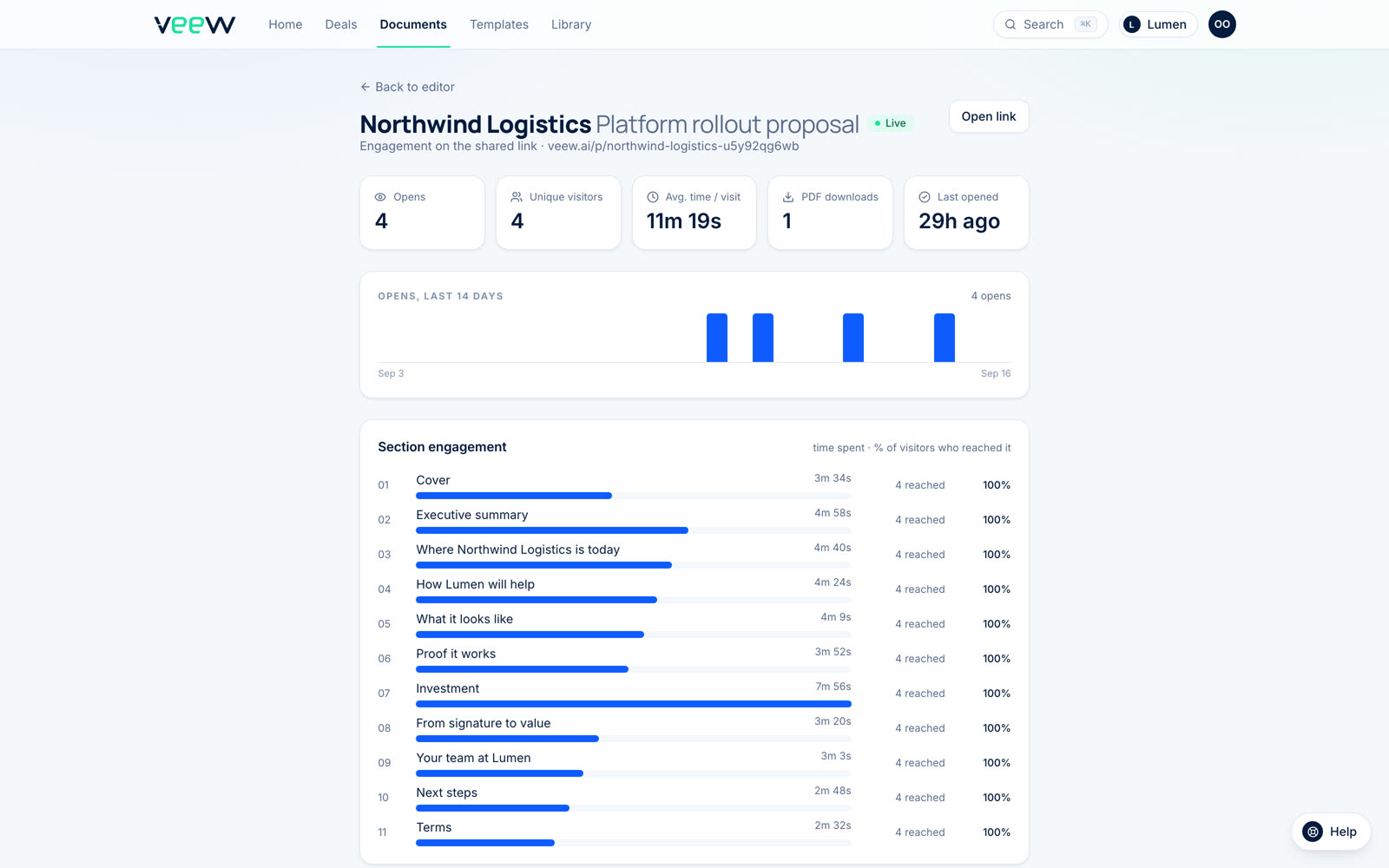
Treat these as signals of interest, not intent; one open proves very little. Then measure the process over a quarter: time from discovery call to proposal sent, how much of each AI draft reps rewrite (a lot means your inputs need work), and win rate against your own baseline. Be skeptical of anyone else's benchmark, ours included.
If you're not ready for dedicated software
Every rule here works by hand. Start from a solid structure, such as our sales proposal template, follow the section-by-section approach in how to write a sales proposal, use a chatbot only for the narrative sections, and paste prices and proof in yourself from their sources. It's slower, but the principles are the same: the model writes, your systems supply the facts, and a person signs off.
AI sales proposal FAQ
Can AI write a sales proposal?
Yes, and it does the narrative sections well when it has real deal context: the summary, the challenges, the approach, the next steps. It shouldn't write the prices, the terms, or the proof. Those should come from your systems, and a person should read the whole thing before it's sent.
Is it safe to put pricing in an AI proposal?
It's safe when the prices come from your catalog or CPQ into a structured table the AI can't rewrite. It isn't safe to ask a model to type or restate prices in prose, because it can round, misapply discounts, or produce a total that doesn't match the line items.
Will buyers know a proposal was written by AI?
They'll notice if it sounds generic, which is the real problem. A short proposal that quotes the buyer's own priorities and cites a relevant real customer reads as attentive. Filler words and vague benefits read as AI.
What's the difference between an AI proposal generator and proposal software?
Many AI proposal generators produce text from a form or prompt. Proposal software manages the document: templates, design, pricing, sharing, tracking, often e-signature. Deal-grounded tools combine the two, writing from your CRM and notes into a finished, trackable document.
Can ChatGPT write a sales proposal?
It can draft good proposal copy if you give it detailed context and check every fact. You still supply pricing and proof, design the document, and track it some other way. For the occasional proposal that's fine; at volume, the copying and checking becomes the bottleneck.