Most proposal statistics on the internet are a decade old, quoted from a page that quoted another page, with the original long gone. We wanted numbers you can plan 2027 around, so we went back to the primary sources and read every figure on the publisher's own page or in the report itself. Where a popular stat couldn't be traced, we left it out and say why at the end.
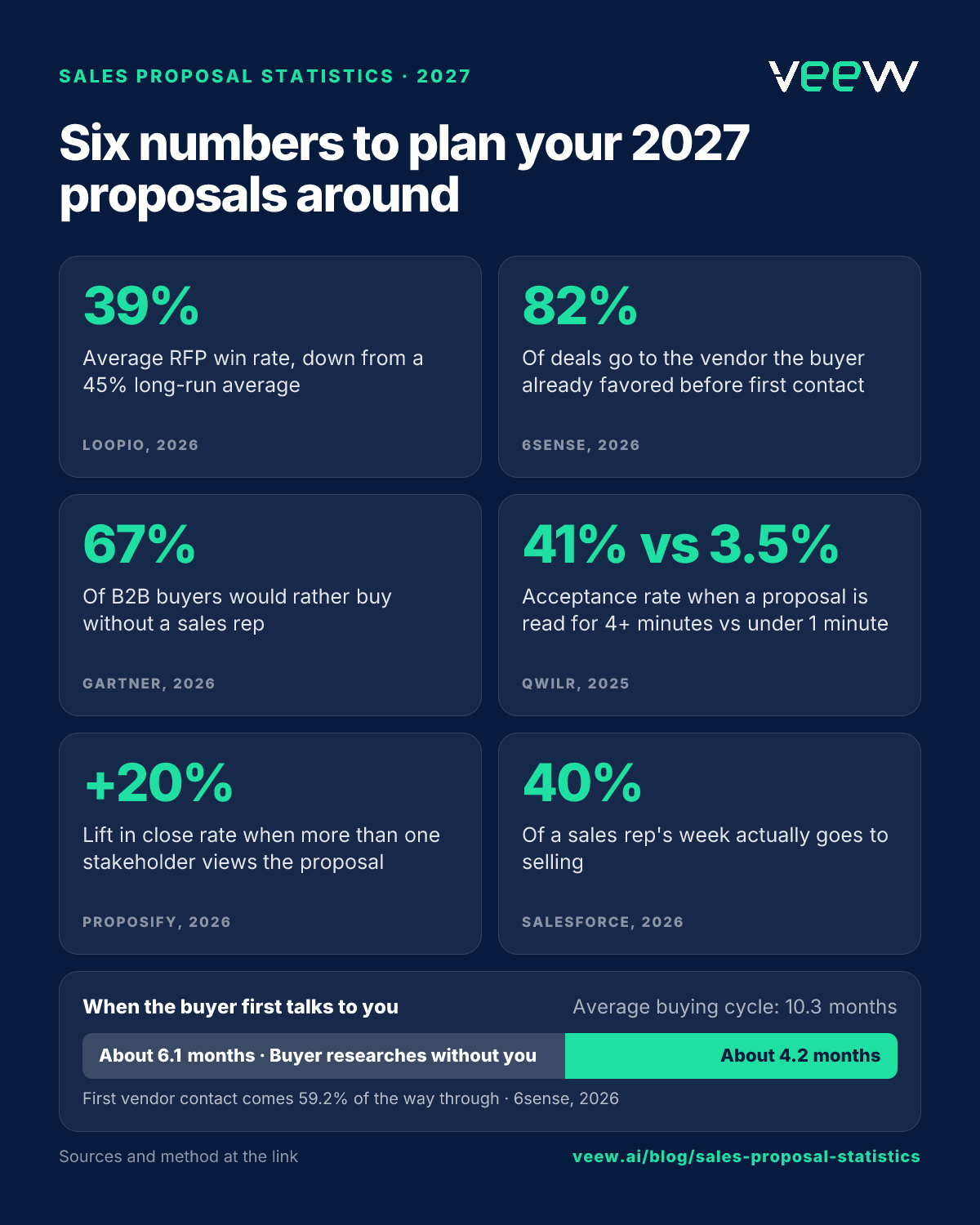
Six numbers to plan your 2027 proposals around
Average RFP win rate, down from a 45% long-run average
Loopio, 2026
Of deals go to the vendor the buyer already favored before first contact
6sense, 2026
Of B2B buyers would rather buy without a sales rep
Gartner, 2026
Acceptance rate when a proposal is read for 4+ minutes vs under 1 minute
Qwilr, 2025
Lift in close rate when more than one stakeholder views the proposal
Proposify, 2026
Of a sales rep's week actually goes to selling
Salesforce, 2026
When the buyer first talks to you
Average B2B buying cycle: 10.3 months
6sense, 2026 · month split is our arithmetic
Sales proposal statistics at a glance
The figures most worth knowing, with where each comes from. The sections below add context and what to do about each.
| Statistic | Figure | Source |
|---|---|---|
| Average RFP win rate | 39% | Loopio, 2026 |
| RFPs that reach the shortlist | 46% | Loopio, 2026 |
| Hours spent per RFP response | 33 | Loopio, 2026 |
| Average close rate of proposals sent through Proposify | 34% | Proposify, 2026 |
| Point in the buying cycle when buyers first contact a vendor | 59% | 6sense, 2026 |
| First vendor contacts initiated by the buyer, not the seller | 82% | 6sense, 2026 |
| Deals won by the vendor favored before first contact | 82% | 6sense, 2026 |
| Average size of a buying group | 10 people | 6sense, 2026 |
| B2B buyers who prefer a rep-free experience | 67% | Gartner, 2026 |
| Buyers who want a rep to validate AI-generated insights | 69% | Gartner, 2026 |
| Acceptance rate, proposal read 4+ minutes vs under 1 minute | 41% vs 3.5% | Qwilr, 2025 |
| Views of a winning vs a losing proposal | 12 vs 8 | Proposify, 2026 |
| Average time from sending a proposal to first open | 34 min | Proposify, 2026 |
| Win-rate lift from multi-threading, deals over $50K | +130% | Gong Labs, 2025 |
| Likelihood of qualifying a lead contacted within an hour | 7x | Harvard Business Review, 2011 |
| Share of a sales rep's week spent selling | 40% | Salesforce, 2026 |
| Proposal teams using generative AI | 79% | Loopio, 2026 |
Proposal and RFP win rates
The average RFP win rate in Loopio's 2026 benchmark of 1,500+ teams. The 45% figure you'll see quoted elsewhere is Loopio's average across 2019 to 2026, so this year's number is lower than the long-run one.[1]
The same report shows the work behind that rate. Teams reach the shortlist on 46% of bids (down from 54% the year before), spend 33 hours on each response, involve nine contributors, and answer 166 RFPs a year on average.[1] RFPs still influence 30 to 40% of those companies' revenue. Win rates vary by region: 47% in the UK, 39% in Europe, and 37% in North America.[1]
Outside formal RFPs, the best public number is vendor data: proposals sent through Proposify in 2025 closed at an average rate of 34%, across 742,137 proposals in 30 industries.[7] Responsive and APMP, who don't publish an overall average, classify “leading” response teams as those winning 40% or more.[2]
What it means for you
A win rate around 35 to 45% on qualified deals is normal; if yours is far below, the problem is usually which deals get a proposal, not how the proposal is written. If it's far above, you may be quoting too late, after the buyer has decided. Track it by stage and by deal source, not as one blended number.
How B2B buyers buy now
How far through the buying cycle buyers are, on average, when they first contact a vendor. 6sense measured the average cycle at 10.3 months, so that's roughly six months of research before you hear from them.[3]
Of deals go to the vendor the buyer already favored before first contact. The buyer, not the seller, initiated 82% of those first contacts, and the eventual winner was on the day-one shortlist in 92% of journeys.[3]
Buyers in the 6sense study considered 4.9 vendors and worked in buying groups of about 10 people.[3] Gartner puts the range at five to 16 people across as many as four functions, and found that 74% of buying teams show “unhealthy conflict” during the decision. Groups that reach consensus are 2.5 times more likely to report a high-quality deal.[5]
Of B2B buyers prefer a rep-free buying experience, up from 61% a year earlier, and 70% prefer a fully digital, self-service purchase.[4]
The same Gartner survey has the counterweight: 69% of buyers prefer to validate AI-generated insights with a sales rep. Buyers used an average of seven information sources on a recent purchase, and 45% used generative AI along the way.[4] They also trust both channels about equally little: 51% expect to meet misleading information from GenAI, 49% from a rep. In the earlier survey, 73% said they actively avoid suppliers who send irrelevant outreach, and 69% had noticed inconsistencies between a supplier's website and what its sellers told them.[6]
What it means for you
By the time a proposal is requested, most of the decision is made, and it will be read by people you never met. The proposal has to carry the case on its own: the buyer's problem in their words, a price that's easy to find, and proof that matches what your website says. Our guide to writing a sales proposal walks through each section with that reader in mind.
How buyers read proposals
Acceptance rate for proposals read for more than four minutes, against those read for under one minute. Vendor data, from 1,064,667 proposals sent through Qwilr.[8]
Qwilr also found acceptance nearly doubled when at least two additional people viewed a proposal within five days of it being sent.[8] Proposify's data points the same way: when more than one stakeholder views a proposal, its close rate rises 20%.[7]
- Times viewed
- Won: 12Lost: 8
- Minutes spent reading
- Won: 25.3 minLost: 15.8 min
- Pages long
- Won: 11Lost: 13
Winners are opened more and read longer, and they're slightly shorter: 11 pages on average against 13.[7] The pace is quick, too. Proposify users took 17 minutes to build a proposal, buyers opened it an average of 34 minutes after it was sent, and won deals closed 2.5 days after the first open. Eighty-three percent of winning proposals included images. Only 20% included a video, but a proposal whose video was watched was 3.3 times more likely to close. Proposals with an e-signature closed at a 15% higher rate and 60% faster.[7]
What it means for you
Reading time and extra viewers are the two engagement signals with the clearest link to a win, and both are measurable. A proposal read for 30 seconds by one person is a warning; one read three times by people you haven't met is a buying committee at work. See how to track proposal engagement and how to tell if a proposal was opened for the mechanics. Correlation isn't causation here: interested buyers read longer, so padding a proposal won't buy you minutes. Shorter, with the price easy to find, is what the length data suggests.
Buying groups and multi-threading
Average win-rate lift from multi-threading in deals over $50K, from Gong's analysis of 1.8 million opportunities closed in 2024. Vendor data.[9]
Most deals are already multi-threaded (77%), and won deals involve twice as many buyer contacts as lost ones.[9] An older Gong study of 500,000+ emails found about eight emails a week went back and forth on deals that closed, against just under two on deals that didn't.[10]
What it means for you
Write the proposal to be forwarded. A champion will pass it to finance, IT, and a sponsor who missed every call, so each should find their section without a walkthrough. A short one-pager for the executive and a shared deal space for the whole group both help a proposal travel.
Speed and follow-up
How much more likely a company was to qualify a web lead if it responded within an hour, compared with waiting even one hour longer. After 24 hours, the gap was more than 60 times.[11]
This Harvard Business Review audit of 2,241 US companies is from 2011, but it's still the most rigorous public study on response speed. At the time, only 37% of companies responded within an hour, 24% took more than a day, and 23% never responded at all; the average response took 42 hours.[11]
On follow-up, Belkins' analysis of 7.5 million outbound emails sent in 2025 found that steps two through six of a sequence produced 58.6% of all replies, so stopping after the first email forfeits more than half of them. It recommends three to five steps.[12] That's cold outbound rather than proposals, but the lesson carries: most responses come after the first touch.
What it means for you
Buyers open proposals within the hour, so the best moment to follow up is soon after the first open, not on a fixed three-day timer. Our proposal follow-up email templates are organized by what the buyer did, opened or not.
AI in sales and proposals
Of proposal and RFP teams use generative AI, up from 68% a year earlier. Sixty-two percent use it to generate specific answers.[1]
In the Responsive and APMP survey, 54% of organizations were trialing or had fully deployed AI in their response workflows.[2] Across sales more broadly, only 8% of reps in HubSpot's survey said they didn't use AI at all.[14] Salesforce's seventh State of Sales report found 54% of sales teams already use AI agents and another 34% expect to within two years, yet reps still spend only 40% of their week selling; the other 60% goes to non-selling work.[13] In McKinsey's 2026 survey, nearly nine in ten respondents said their organizations use AI regularly in at least one function, and that revenue gains from AI are most often attributed to marketing and sales.[15]
What it means for you
Using AI is no longer an edge. The edge is what it's grounded in. A draft written from the CRM deal and the call notes reads like you listened; one written from a prompt reads like everyone else's. Prices and proof should come from your systems, not the model. Our guide to AI sales proposals covers where that line sits, and from call notes to proposal covers the input that matters most.
Seven takeaways for 2027
- Get on the shortlist early. The pre-contact favorite wins 82% of the time; the proposal confirms a lead you built before it.
- Write for readers you haven't met. Buying groups average ten people, and close rates rise 20% when more than one of them reads it.
- Make it readable in four minutes. That's where acceptance climbs; winners are shorter, not longer.
- Be ready at the first open. It comes within the hour, and the deal often closes within days of it.
- Keep the website and the proposal saying the same thing. Most buyers have noticed when they don't.
- Measure win rate by stage and source. A blended 39% hides where deals are really lost.
- Ground the AI. Nearly every team uses it now; the ones who feed it the deal get the proposals that sound specific.
Popular statistics we left out, and why
These numbers circulate widely. We couldn't trace them to a current primary source, or the source doesn't say what the quote claims, so they're not on this page.
- “Buyers spend only 17% of their time meeting suppliers.” Widely attributed to Gartner, but the Gartner page it came from now redirects, and we couldn't find the figure, its year, or its sample on any current Gartner page. Gartner's current numbers on group size and rep-free buying are above.
- “Respond in five minutes and you're 100 times more likely to connect.” This comes from a 2007 study by a sales software vendor covering six companies, not from the HBR research it's often credited to, and that study itself notes it didn't measure close rates. We used the HBR audit instead.
- “The average deck gets 2 minutes 24 seconds.” DocSend's published reading-time data is about investors reading startup pitch decks, not buyers reading proposals, and we couldn't find this exact figure in it.
- “The industry average proposal close rate is 20%.” Repeated on several vendor sites with no source. The closest sourced numbers are Loopio's 39% for RFPs and Proposify's 34% for its users.
- “6 to 10 decision makers in a typical buying group.” An older Gartner range that no longer appears on a live Gartner page. The current published range is five to 16 people.
Sources and methodology
We read each figure on the publisher's page or in the report itself in November 2026. Where a report has a newer edition, we used it. Survey data describes what respondents said; vendor data describes that vendor's customers. Neither proves cause and effect.
- 1.Loopio, RFP Response Trends & Benchmarks Report (7th annual) (2026). Survey of 1,500+ response-management teams across 17+ industries.
- 2.Responsive and APMP, State of Strategic Response Management (2025). Survey of 726 revenue leaders and response practitioners.
- 3.6sense, B2B Buyer Experience Report (2026). 3,596 completed-purchase journeys and 1,011 no-decision journeys.
- 4.Gartner, Survey finds 69% of B2B buyers turn to sales reps to validate AI-generated insights (2026). Survey of 645 B2B buyers, August to September 2025.
- 5.Gartner, Sales survey finds 74% of B2B buyer teams demonstrate unhealthy conflict (2025). Survey of 632 B2B buyers, August to September 2024.
- 6.Gartner, Sales survey finds 61% of B2B buyers prefer a rep-free buying experience (2025). Survey of 632 B2B buyers, August to September 2024.
- 7.Proposify, State of Proposals 2026 (2026). 742,137 proposals sent through Proposify in 2025, across 30 industries. Vendor data.
- 8.Qwilr, The death of static proposals (2025). 1,064,667 proposals sent through Qwilr. Vendor data.
- 9.Gong Labs, Data shows top reps don't just sell, they orchestrate with AI (2025). 1.8 million new-business opportunities closed in 2024. Vendor data.
- 10.Gong Labs, The signal all winning deals have in common (2019). 500,000+ sales emails. Vendor data.
- 11.Harvard Business Review, The short life of online sales leads (2011). Audit of web-lead response at 2,241 US companies.
- 12.Belkins, Sales follow-up statistics (2026). 7.5 million outbound emails sent in 2025. Vendor data.
- 13.Salesforce, State of Sales, 7th edition (2026). Survey of 4,050 sales professionals in 22 countries, August to September 2025.
- 14.HubSpot, State of Sales report (2025). Survey of 1,000 sales professionals worldwide.
- 15.McKinsey & Company, The state of AI (2026). Survey of 1,719 participants in 97 countries, May to June 2026.
Use these statistics
You're welcome to quote any number on this page or republish the infographic, as long as you link back to this page as the source. Cite the original publisher for individual figures. The infographic is also available as a 1200 × 1500 PNG.
<a href="https://veew.ai/blog/sales-proposal-statistics"><img src="https://veew.ai/blog/sales-proposal-statistics/infographic.png" alt="Sales proposal statistics for 2027 infographic by Veew" width="1200" height="1500" /></a>
<p>Source: <a href="https://veew.ai/blog/sales-proposal-statistics">Sales proposal statistics for 2027, Veew</a></p>
Frequently asked questions
What is the average sales proposal win rate?
For formal RFPs, Loopio's 2026 benchmark puts the average win rate at 39%, down from a 45% average across 2019 to 2026. For proposals sent through Proposify in 2025, the average close rate was 34%. Treat roughly 35 to 45% as normal for qualified opportunities and anything above 45% as strong; Responsive and APMP define leading response teams as those winning 40% or more.
What is a good RFP win rate in 2027?
Above 40%. Loopio's 2026 survey of 1,500+ teams found an average of 39%, with UK teams at 47% and North American teams at 37%. Win rate depends heavily on bid selection: teams that decline poorly qualified RFPs usually post higher rates than teams that answer everything.
How long do buyers spend reading a sales proposal?
In Proposify's 2025 data, buyers spent an average of 25.3 minutes across all views of a winning proposal and 15.8 minutes on a losing one, and opened winners 12 times versus 8. Qwilr found proposals read for more than four minutes were accepted 41% of the time, against 3.5% for those read under a minute.
How many people are involved in a B2B buying decision?
6sense's 2026 Buyer Experience Report puts the average buying group at about 10 people. Gartner reports groups of five to 16 people across as many as four functions. Proposify found close rates rise 20% when more than one stakeholder views a proposal.
When do B2B buyers first contact a vendor?
About 59% of the way through the buying cycle, according to 6sense's 2026 report, which measured an average cycle of 10.3 months. The buyer, not the seller, initiated 82% of first contacts, and the vendor the buyer favored before that contact won 82% of the time.
How quickly should you follow up on a proposal or lead?
Fast. Harvard Business Review's audit of 2,241 US companies found that firms contacting a web lead within an hour were nearly seven times as likely to qualify it as firms that waited even one more hour. For proposals, Proposify's data shows the average buyer opens within 34 minutes of sending, so the first open is the moment to be ready, not days later.
Do B2B buyers still want to talk to sales reps?
Less than they used to, but they still rely on them. Gartner's 2026 survey found 67% of B2B buyers prefer a rep-free experience, yet 69% prefer to validate AI-generated insights with a sales rep. Buyers want self-serve research and a credible human to confirm what they found.